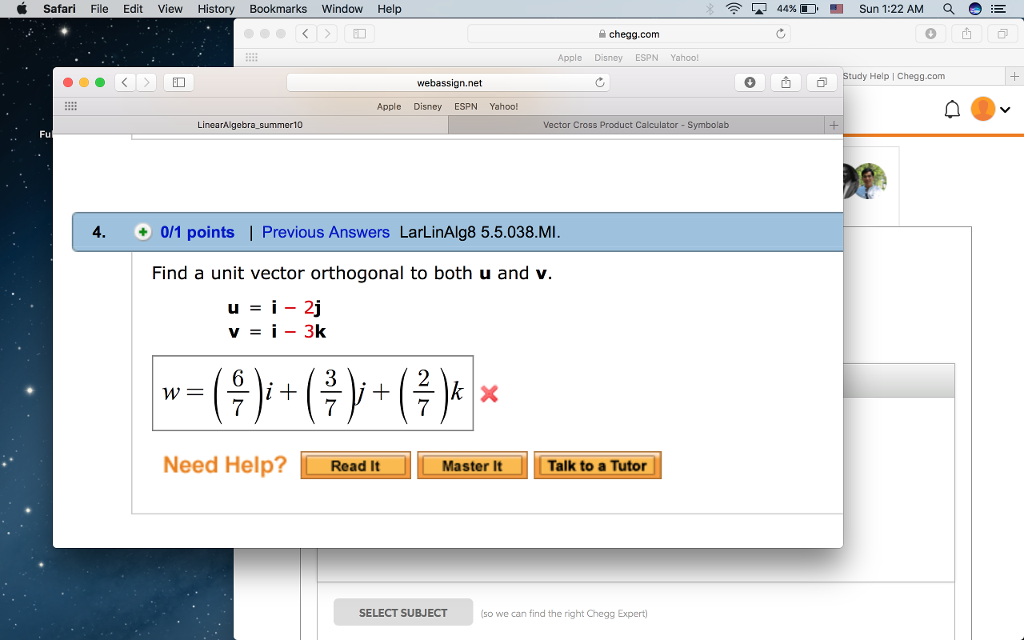
Find A Unit Vector That Is Orthogonal To Both U And V
Find A Unit Vector That Is Orthogonal To Both U And V. Were given two vectors u and v in our task is to find a vector orthogonal to you and be so a vector perpendicular to both you envy and a unit vector that is perpendicular to both you and v to do part a. Find a unit vector that is orthogonal to both u and v.
Solved Find A Unit Vector Orthogonal To Both U And V. U from www.chegg.com
There are many possible solutions for a, b, c which satisfy both of these equations. We need to find unit vector. The cross product of 2 vectors, → a = a,b,c and → b = d,e,f is given by the determinant ∣∣ ∣ ∣ ∣ ˆi ˆj ˆk a b c d e f ∣∣ ∣ ∣ ∣
All We Have To Do Is Simply Find The Cross Product Because From The Cross Product Theorem, We Know That You Cross B Is Perpendicular To Both You And V.
Therefore, w1, w2, and w3 must satisfy u1w1 + u2w2 + u3w3 = 0 v1w1 + v2w2 + v3w3 = 0. Finding the orthogonal vector is simple: Use the cross product to find a vector that is orthogonal to both u and v.
V = 10, −18, −2.
U and v are orthogonal if u ⋅ v = 0. You want a vector ( a, b, c) such that ( a, b, c) ⋅ ( 1, 0, 1) = 0 and ( a, b, c) ⋅ ( 0, 1, 1) = 0. The cross product of the two given vectors is orthogonal to both.
Find A Unit Vector That Is Orthogonal To Both U And V.
Were given two vectors u and v in our task is to find a vector orthogonal to you and be so a vector perpendicular to both you envy and a unit vector that is perpendicular to both you and v to do part a. How do you find a unit vector that is orthogonal to both u = (1, 0, 1) v = (0, 1, 1)? Use the cross product to find a vector that is orthogonal to both u and v.
1 🔴 On A Question Find A Unit Vector That Is Orthogonal To Both U And V.
Read it talk to a tutor submit answer practice another version 7. How do you find a unit vector that is orthogonal to both u = (1, 0, 1) v = (0, 1, 1)? Find the unit vector in the direction of u, and write your answer in component form.
Where Did W Come From?
Type the coordinates of the vectors; Find a unit vector orthogonal to both u and v. Dec 28, 2016 the answer is = 1 5 0, −4, − 3 explanation: