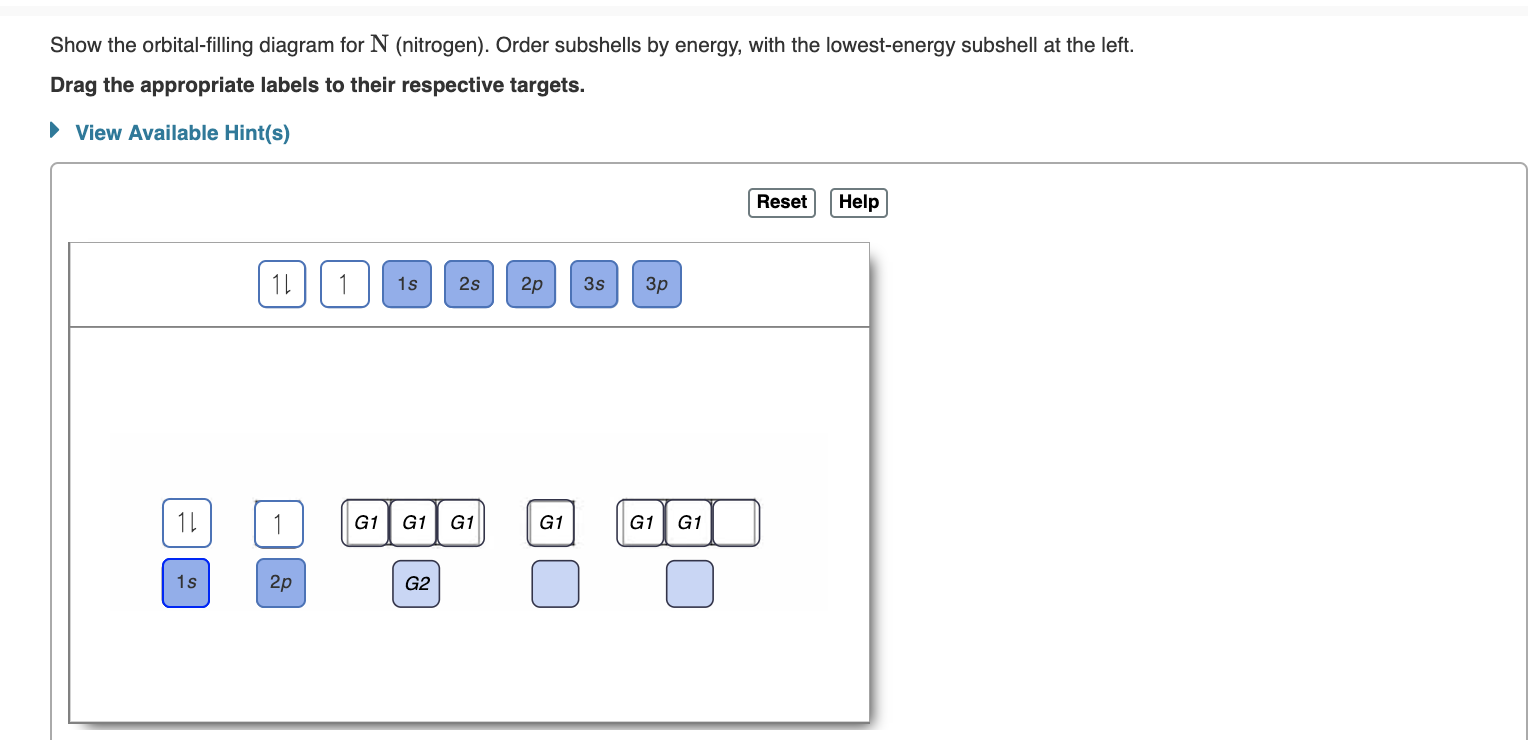
Show The Orbital Filling Diagram For Nitrogen. The standard atomic mass of nitrogen is 14.006. Nitrogen is the seventh element with a total of 7 electrons.
Solved Show The Orbitalfilling Diagram For N (nitrogen from www.chegg.com
The remaining three electrons will go in the 2p orbital. The standard atomic mass of nitrogen is 14.006. In writing the electron configuration for nitrogen the first two electrons will go in the 1s orbital.
In The Same Way, The Orbital Filling Diagram For Nitrogen Will Be.given The Same Amount Of Absorbed Solar Energy Coming In, The Amount Of Ir Escaping To Space At The Top Of The Atmosphere Will Indeed Be The Same No Matter How Many Greenhouse Gases There Are (Assuming The System Is.
The atomic number of nitrogen is 7 and its symbol is ‘n’. Drag the appropriate labels to their respective targets. Nitrogen is the seventh element with a total of 7 electrons.
If You Are Still Not Getting The Nitrogen Electron Configuration Of The Element Nitrogen Then, The Full Electronic Configuration Of Nitrogen Is Written As The Following;
Stack the subshells in order of energy,. Drag the appropriate labels to their respective targets. The remaining three electrons will go in the 2p orbital.
If We Gave You Brief Information Then, The First Two Electrons Lie In The 1S Orbital, Following The Next 2 Electrons, It Comes Under The 2S Orbital.
In the same way, the orbital filling diagram for nitrogen will be: Since 1s can only hold two electrons the next 2 electrons for n goes in the 2s orbital. In writing the electron configuration for nitrogen the first two electrons will go in the 1s orbital.
Orbital Filling Diagrams Essentially Just Turn This Big List Of Electron Locations.
However, in ethane an sp 3 orbital of one carbon atom overlaps end to end with an sp 3 orbital of a second carbon atom to form a σ bond between the two carbon atoms. And that’s the basic idea behind orbital filling diagrams! Describe the two differences between a 2p x orbital and a 3p y orbital.
1S 2 2S 2 2P 3.
Nitrogen (n) electron configuration with full orbital diagram. An orbital structure is the space in an atom that’s occupied by an electron. It’s not until we reach oxygen, where the electrons will start to double up, just because there’s no alternative: