C Q M Delta T. Note that 1 cal = 4.186 j. I thought that q=m delta h was only used to find the amount of energy needed to heat, freeze, and boil h20, and q=mc delta t was used to find the amount of heat needed to heat something up.
mc(deltaT) = mc(deltaT) YouTube from www.youtube.com
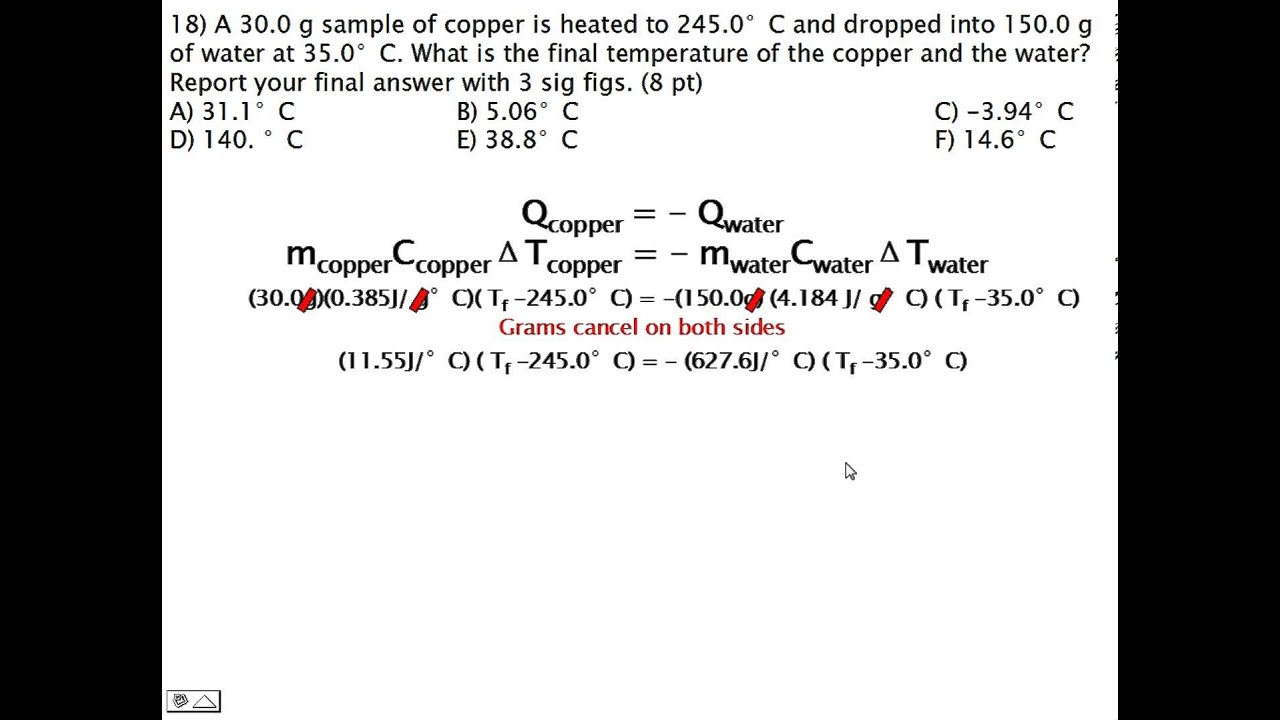
Q = m*c*\delta t\, where q = heat flow, m = mass, c = specific heat capacity, and \delta t\ = change in temperature. D s = δ q t {\displaystyle ds= {\frac {\delta q} {t}}} , for reversible processes only. C is equal to specific heat capacity.
Q = M Cp Dt The Equation I Used The Most As An Energy Engineer.
The variables in the equation q = mcdeltat mean the following: Q= m x ce x δt fórmula de las cantidades de calor (q) donde: M is the mass of the substance, in kg;
Calculate The Heat Absorbed By 15.0 G Of Water To Raise The Temperature From 20.0 O C To 50.0 O C (At Constant Pressure).
The heat of fusion for water is 334 j/g q= m= h = 2. Δt el incremento de temperatura que experimenta el cuerpo. 1 kj = 1,000 j.
The Temp Of The Water Went Down Then The Reaction Was Endothermic And Qreaction Must Be Positive, Or
T = q divided by the quantity m times c. Apply q reaction = (m) (c) (∆t), where delta t is an absolute value so q reaction is always positive initially, then 2. And delta t is the temperature change, in °c.
M Is The Mass Of The Substance, In Kg;
\frac{mt\delta c}{mt\delta }=\frac{q}{mt\delta } dividing by m\delta t undoes the multiplication by m\delta t. I thought that q=m delta h was only used to find the amount of energy needed to heat, freeze, and boil h20, and q=mc delta t was used to find the amount of heat needed to heat something up. Q = 0,5 kg x 4200 j/kg 0 c x 50 0 c.
Mc\Delta T=Q The Equation Is In Standard Form.
let: q=heat energy gained or lost by a substance. Hot water loops are commonly used to transfer heat in district heating networks and on industrial sites. C is the specific heat capacity of the material, in ##j/(kg * °c)##;