Find Lattice Energy. When two ions react together, it will release the exothermic heat. Q2 is the numerical ion charge of ion 2.
How To Find Lattice Energy Born Haber Cycle from goodttorials.blogspot.com
Beside above, how do you find the lattice energy of rbcl? the lattice energy of an ionic solid is a measure of the strength of bonds in that ionic compound. Lattice energy (u) is the energy required to completely separate one mole of a solid ionic compound into gaseous ions.
For Nacl(S) Sample Exercise 11.2.
By comparing the lattices of substances from the same group or period, the lattice energy trend may be determined. The lattice energy of a crystalline solid is a measure of the energy released when ions are combined to make a compound. Lattice energy depends on the strength of interactions between cations and anions in the lattice, which we can estimate using coulomb’s law:
We Can Compute The Lattice Energy Of Nearly Any Ionic Solid By Using A Modified Form Of Coulomb’s Law.
Extra lattice energy problems chm 11500 fall 2014. R is the distance between ions. The lattice energy of an ionic compound is the energy change when one mole of ionic solid is separated into its gaseous ions.
The Lattice Energy Of An Ionic Solid Is A Measure Of The Strength Of Bonds In That Ionic Compound.
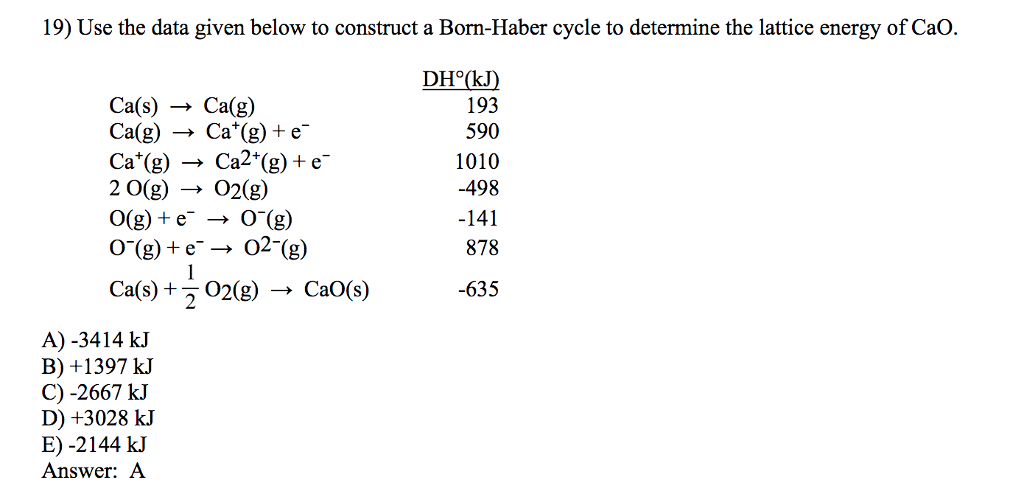
How do you find the lattice energy of cacl2? The net enthalpy of formation and the first four of the five energies can be determined experimentally, but the lattice energy cannot be measured directly. According to this equation, stronger interactions occur between ions with larger charges and smaller radii.
Δ G U Denotes The Molar Lattice Energy.
The enthalpy change involved in the production of ionic solids from gaseous ions, or the energy involved in breaking the ionic solids into gaseous ions, is referred to as the lattice energy. Given the data below, find lattice energy for kbr, which is the ho for the following reaction: Lattice energy (e) increases as q increases and/or as r decreases.
The Molar Lattice Energy Of An Ionic Crystal Can Be Expressed In Terms Of Molar Lattice Enthalpy, Pressure, And Change In Volume Via The Following Equation:
The formula for ionic lattice energy. Na+ (g) + cl− (g) → nacl (s) the experimental lattice energy of nacl is −787 kj/mol. Lattice energy refers to the energy that is released when two oppositely charged gaseous ions attract to each other and form an ionic solid.