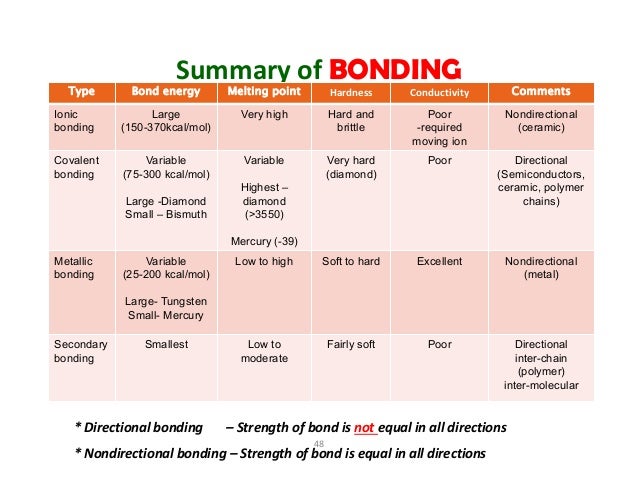
Ionic Bonds Vs Covalent Bonds Strength. Ionic bonds donate electrons between atoms, and covalent bonds share electrons. Covalent bond the shared electron are kept together by van der waal forces of attraction only.
Mec281 lecture from www.slideshare.net
Ionic bonds form because of the attraction between two differently charged ions (atoms with missing or extra electrons). The difference between ionic and covalent bonds is in their hardness. These bonds are the strongest out of the list.
The Only Pure Covalent Bonds Occur Between Identical Atoms.
Covalent bonds tend to be weaker than ionic or metallic bonds, so they require less energy to break. Covalent bond does not react fast and is comparatively low reactive whereas ionic. Ionic bonds are strong but not as strong as purely covalent network solids.
But Do You Know Which Is Stronger?
Ionic bonds vs covalent bonds (which is stronger?) if playback doesn't begin shortly, try restarting your device. The further apart 2 elements are in the periodic table, the stronger the bond. In an ionic bond, there is a formation of the crystal lattice structure that is usually attracted by a strong electrostatic force of attraction.
The Main Difference Between Covalent And Ionic Bonds Is How They Share Electrons.
The two main types of chemical bonds are ionic and covalent bonds. Covalent bond the shared electron are kept together by van der waal forces of attraction only. It depends what you mean by strength.
Covalent Bonds Stable Molecules Exist Because Covalent Bonds Hold The Atoms Together.
What are some cases where ionic bond is stronger (ie. In general, covalent bond is stronger than ionic bonds, correct? The number of electrons transferred between two atoms involved in the bond is known as the electrovalency of the atoms.
Materials Are Sometimes (16) _ By The Type Of Bonding Between The Atoms:
Ionic bonds form because of the attraction between two differently charged ions (atoms with missing or extra electrons). So, to a mineralogist, covalent bonds look strong compared to other types of bond. You'd think this was a straightforward question.