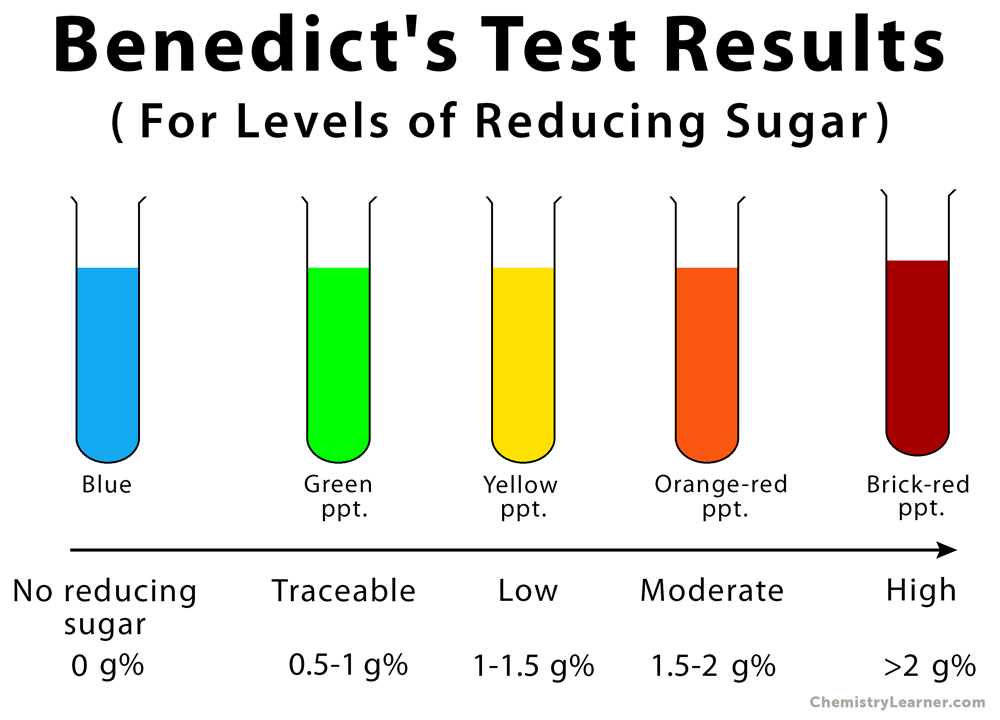
Benedict Test Results. Result interpretation of benedict’s test. 6 rows benedict’s test can also be used for checking the presence of glucose in a sample of urine.
Benedict’s test Definition, Principle, Uses, and Reagent from www.chemistrylearner.com
Benedict’s solution contains milder alkali na2co3. In order to establish the differences between the benedict nq method and the quantitative method proposed in the present work (benedict q), figure figure1 1 shows a comparative scheme between both. Brick red with heavy precipitate 2% or >2%.
Take Your Favorite Kinds Of Cereal And Do Benedict’s Test With It.
Take some avocados and mash it and do sudan iii test with it and record the result on the data table. Major differences were the final reaction volume decrement from 6 to 1.5 ml, comprising 1 ml of the reagent and 0.5 ml of the sample. Yellow precipitate indicates 1 g% concentration;
Record The Results On The Data Table.
Benedict’s solution contains milder alkali na2co3. Observation (results) of benedict’s test. Such tests that use this reagent are called the benedict's tests.
The Benedict Solution Is A Test For Monosaccharides;
Drop 8 to 10 drops of urine into the boiling benedict's solution. The color of the reagent could change at a varying degree, which indicates a certain amount of sugar present in the solution. The benedict's test allows us to detect the presence of reducing sugars (sugars with a free aldehyde or ketone group).
If The Color Upon Boiling Is Changed Into Green, Then There Would Be 0.1 To 0.5 Percent Sugar In Solution.
If it changes to orange, then it means that 1. No change in color (sucrose) and water; Observation (results) of benedict’s test.
Since The Intensity Of Red Color And The Volume Of Precipitate Change With The.
Benedict’s test colors are important in result interpretation. Add about 1 cm 3 depth of water to the tube and stir to mix. Take different kinds of sugar and do benedict’s test on them;