D Vt 1 2At 2. Calculate displacement as a function of initial velocity, acceleration and time using the equation s = ut + (1/2)at^2. Move d d to the left side of the equation by subtracting it from both sides.
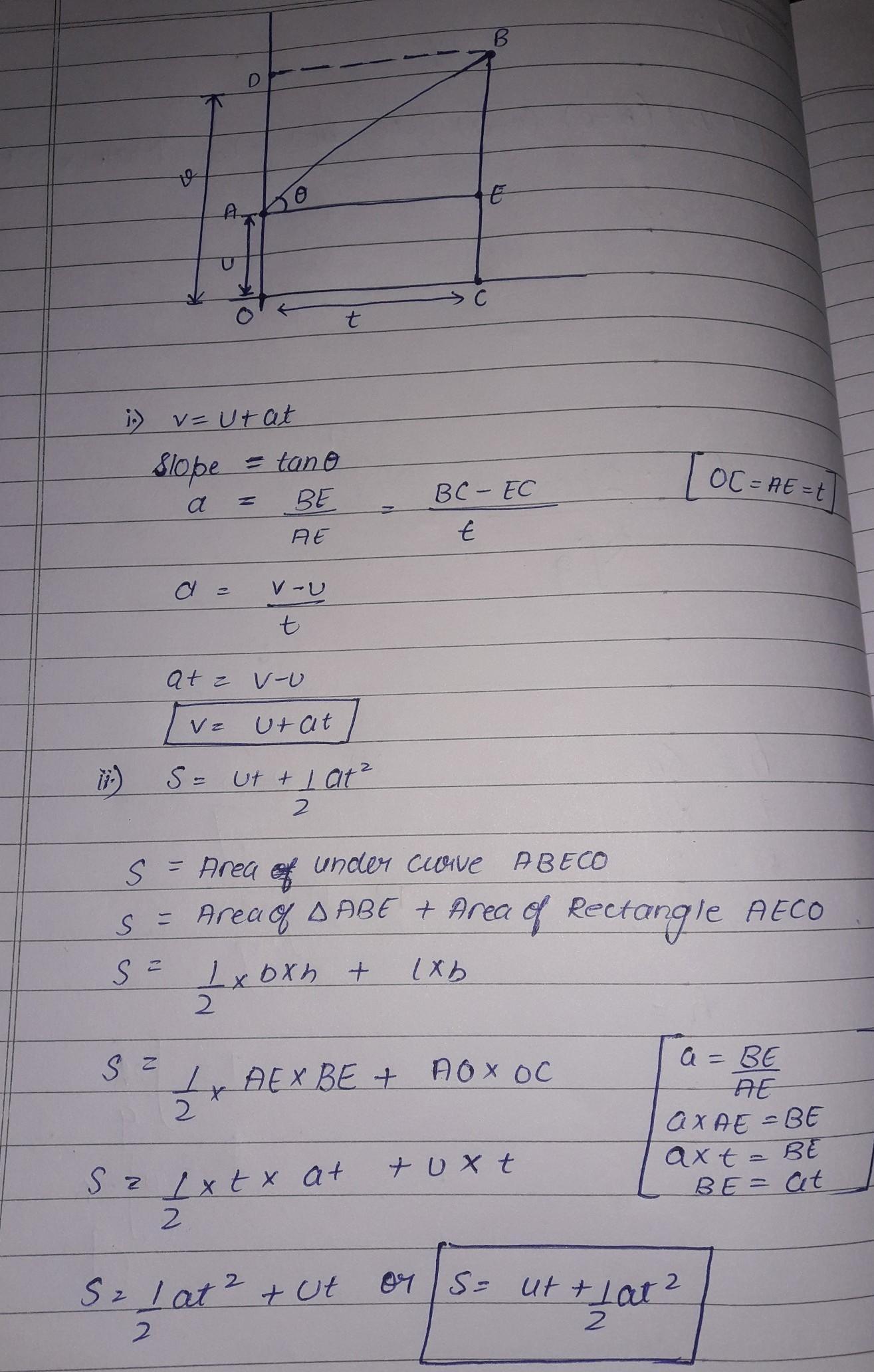
Using VT graph derive equation s=Vt+1/2 at^2 Brainly.in from brainly.in
The first step is to subtract v1t from both sides of the equation: Neither can my algebra teacher. For more information and source, see on this link :
D Vt 1 2At 2.
Douwdek0 and 2 more users found this answer helpful. Vt+ at2 2 = d v t + a t 2 2 = d. Arrange the equations in the correct sequence to rewrite the formula for displacement, d = vt—1/2at^2 to find a.
Go 50 Miles Per Hour (The Velocity) For 2 Hours (The Time) And You Will Go 50 X 2 = 100 Miles.
Steps for solving linear equation. D=vt+1/2at^2 derive me this formula please. C torque aiding the developed torque.
Deriving A Kinematic Equations That Describes The Physics Of Uniformly Accelerated Motion.
I can't seem to isolate it. D=1/2at2 no solutions found rearrange: Move d d to the left side of the equation by subtracting it from both sides.
D=Vit+1/2At^2 Despejar T Despejar Tiempo En Mrua X=X0+V0T+1/2At2 Despejar A Despeje De Aceleracion En Esta Formula D=Vi.
2⋅ 1 2 ⋅(at2) = 2⋅d 2 ⋅ 1 2 ⋅ ( a t 2) = 2 ⋅ d. What is the reason behind this equation? For more information and source, see on this link :
You Can Put This Solution On Your Website!
Displacement, initial velocity, acceleration or time. A.t x=x0 + v0t +1/2at2 despeje del tiempo en formula d = v*t+1/2at2 despejar formula de fisica d=vt+1/2at2 despejar t como despejo la formula x=x0+v0t d vot 1 2at2 despejar t despejar d=vot+1/2at^2. D=ut+1/2at^2 [u is initial velocity, v is final velocity, d is distance, a is acceleration, t is time taken] using first equation of motion (v=u+at), we get: