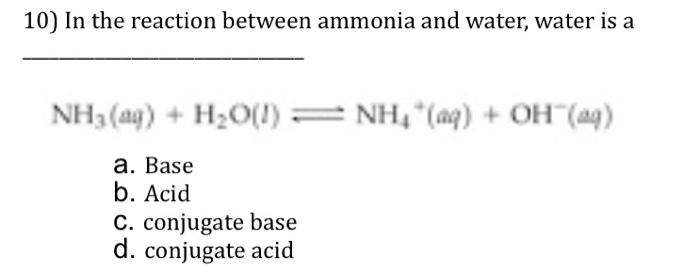
Conjugate Acid Of Ammonia. ' conjugate ' means one proton more (acid) or less (base) than the described acid or base respectively: Nh4+ is conjugate acid because it now has protons to release back to nh3 (base).
Solved 10) In The Reaction Between Ammonia And Water, Wat from www.chegg.com
The conjugate acid of any substance is given by removing an acidic hydrogen. Hi, i'm trying to understand this problem: Acetylene (ethyne) c 2 h 2:
Therefore, Nh4+ Is The Conjugate Acid Of Ammonia.
The formula of the conjugate acid is the formula of the base plus one hydrogen ion. Q2 methylamine (ch3nh2) is a weakly basic compound. Therefore, nh4+ is the conjugate acid of ammonia.
When Nh3 Reacts With H+ Ion, It Donates Its Lone Pair To H+ Ion And Forms Nh4+ As Conjugate Acid.
We say that the water molecule is the conjugate acid of the hydroxide ion after the latter received the hydrogen proton donated by ammonium. Ammonia(nh 3) has an amphoteric nature as it acts as a weak base when reacts with acidic compounds and forms conjugate acid(nh 4 +) by accepting the proton. We call the acetate ion the conjugate base of acetic acid, and the ammonium ion is the conjugate acid of ammonia.
Which Chemical Is The Conjugate Acid When Hcl Reacts With Ammonia?
In the case of ammonium ion, the conjugate base is ammonia. The conjugate acid of ammonia is nh4+, a weak acid. Acetylene (ethyne) c 2 h 2:
Tetrahydrofuran) Nh3 Can Be An Acid.
Which of the following species is the conjugate acid of ammonia, nh3? Giving to the vsepr concept, the bond angle of ammonia is 107.5. It accepts a proton to give its conjugate and nh4+.
Asked Jun 25, 2017 In Chemistry By Halter_Soni.
Ammonia is a base because it is accepting hydrogen ions from the water. C 2 h 5 oh: 5 rows ammonia or nh3 is a base.